Electronics
Basics
Current flows from positivle lead to negative lead.
Kirchoff’s current law: the sum of the currents into a node equals the sum of the current flowing out of the node.
Kirchoff’s voltage law: the sum of the voltages around any closed circuit is zero.
Power
$$ \Large P=VI $$ measured in Watts (W) (Joules per second ( $$ \Large \frac{J}{s} $$ )
Resistor power
$$ \Large P=I^2R $$ and $$ \Large P=\frac{V^2}{R} $$
Resistance
Calculating material resistance
$$ \Large R=\frac{\rho L}{A} $$
$$ \rho - resistivity $$
$$ L - length $$
$$ A - cross sectional area $$
Common $$ \rho $$ values: silver 1.6, copper 1.7, nichrome 100, carbon 3500
Color codes
Band closest to one end is first digit. Second color is second digit and thrid digit is multiplier. Last band is tolerance.
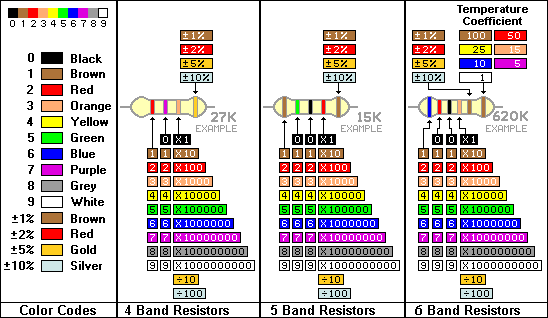
Resistors in cicuit
Resistors in series: $$ R=R_1+R_2+R_3 + … $$
Resistors in parallel: $$ \Large \frac{1}{R}=\frac{1}{R_1}+\frac{1}{R_2}+\frac{1}{R_3} + …$$
Two resistors in parallel: $$ \Large R=\frac{R_1*R_2)}{R_1+R_2} $$
Internal resistance
$$ \Large R_{int}=(\frac{V_{NL}}{V_{FL}}-1)R_L $$
$$ V_{NL} - no: load: voltage $$
$$ V_{FL} - load: voltage $$
$$ R_L - load: resistance $$
RMS (Root mean square)
RMS value for sine wave:
$$ \Large V_{RMS}=V_{pk}\frac{1}{\sqrt{2}}=V_pk*0.7071 $$
RMS combined
$$ \Large V_{RMS}=\sqrt{\frac{V_1^2}{2}+\frac{V_2^2}{2}+…} $$
Twoport
Twoport is described by a matrix of 4 values: 2 currents and 2 voltages.
z-parameters (ohm)
$$\Large V_1=z_{11}I_1+z_{12}I_2 $$
$$\Large V_2=z_{21}I_1+z_{22}I_2 $$
y-parameters (siemens)
$$\Large I_1=y_{11}V_1+y_{12}V_2 $$
$$\Large I_2=y_{21}V_1+y_{22}V_2 $$
h-parameters (h11 ohm, h12 h21 none, h22 siemens)
$$\Large V_1=h_{11}I_1+h_{12}V_2 $$
$$\Large I_2=h_{21}I_1+h_{22}V_2 $$
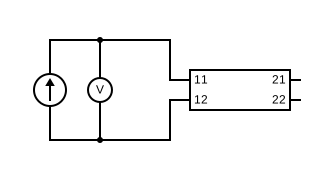 $$\Large z_{11}=\frac{V_1}{I_1} $$ input impedance
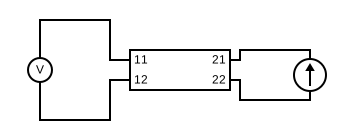 $$\Large z_{12}=\frac{V_1}{I_2} $$ transfer impedance
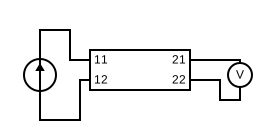 $$\Large z_{21}=\frac{V_2}{I_1} $$ transfer impedance
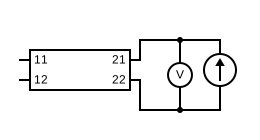 $$\Large z_{22}=\frac{V_2}{I_2} $$ output impedance
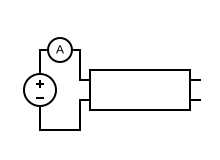 $$\Large y_{11}=\frac{I_1}{V_1} $$ input admittance
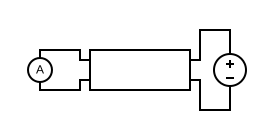 $$\Large y_{12}=\frac{I_1}{V_2} $$ transfer admittance
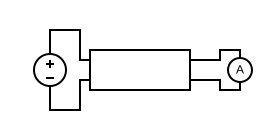 $$\Large y_{21}=\frac{I_2}{V_1} $$ tranfer admittance
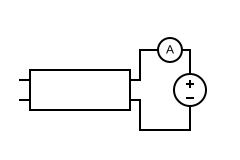 $$\Large y_{22}=\frac{I_2}{V_2} $$ output admittance
h11 and h12
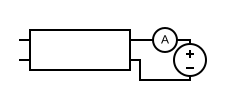 $$\Large h_{11}=\frac{V_1}{I_1} $$ input impedance
$$\Large h_{12}=\frac{V_1}{V_2} $$ voltage transmittance
h21 and h22
$$\Large h_{21}=\frac{I_2}{I_1} $$ current transmittance
$$\Large h_{22}=\frac{I_2}{V_2} $$ output admittance
Capacitor
Capacitor energy
$$\Large W=\frac{IVt}{2}=\frac{qV}{2}=\frac{CV^2}{2}$$
RC circuit
RC - low pass filter
CR - high pass filter
Time constant
Time constant: $$\Large \tau=RC $$
Finding time constant:
- Replace power supplies and measuring devices with their internal resistance
- Simplify as much as possilbe
- Calculate
Inductor
Inductor energy
$$\Large W=L*i^2 $$
RL circuit
RL - step response r(0)=1
LR - step response r(0)=0
Time constant: \(\Large \tau=\frac{L}{R} \)
Cutoff frequency: \( \Large f_{co}=\frac{R}{2\pi L} \)
Carging and discharging voltage
Charging voltage: $$\Large V_C=V_S(1-e^{-\frac{t}{RC}})$$
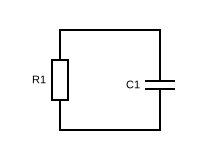
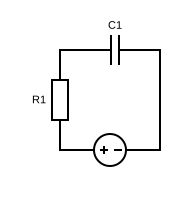 Discharging voltage: $$\Large V_C=V_S*e^{-\frac{t}{RC}}$$
Cutoff frequency
$$\Large f_c=\frac{1}{2\pi RC} $$
i
LED
Forward voltage
$$ V_{forward}=1.7V $$ $$ V_{forward}=2.0V $$ $$ V_{forward}=2.1V $$ $$ V_{forward}=2.2V $$ $$ V_{forward}=3.0V $$Calculating current
$$ \Large I=\frac{V_{supply}-V_{forward}}{R} $$
Logic
NAND latch
| S | R | Action |
| 0 | 0 | Not allowed |
| 0 | 1 | Q=1 |
| 1 | 0 | Q=0 |
| 1 | 1 | No change |
NOR latch
| S | R | Action |
| 0 | 0 | No change |
| 1 | 0 | Q=1 |
| 0 | 1 | Q=0 |
| 1 | 1 | Invalid state |
Ohm’s law
$$ \Large V=IR $$
$$ \Large I=\frac{V}{R} $$
$$ \Large R=\frac{V}{I} $$
Transmittance
Ratio between input and output
$$\Large T=\frac{V_{out}}{V_{in}} $$
$$\Large T=\frac{I_{out}}{I_{in}}$$
Decibel (dB)
The decibel(dB) is a unit of measurment used to express the ratio of one value of a power or field quantity to another on logarithmic scale.
$$\Large L_p=10\log({\frac{P}{P_0}})dB $$
For field quantities it is usual to consider the ratio of the squares of measured field
$$\Large L_F=\ln(\frac{F}{F_0})N_p=10\log({\frac{F^2}{F_0^2}})dB=20\log({\frac{F}{F_0}})dB $$
Same applies for voltages:
$$\Large L_G=10\log{(\frac{V_{out}}{V_{in}})}dB $$